Engineering design preview. Particle removal, ozone control, noise and complete-system performance remain to be measured.
SPATIAL DESIGN STUDYDRAG TO ROTATE
Dimensioned collector and catalyst studies, with an illustrative duct layout. Two parallel banks feed one shared dry finish. This is not a manufactured enclosure.
2isolatable collector banks one can clean while one filters
150 m³/htotal airflow planning basis also required with one bank offline
8honeycomb catalyst blocks in one common cartridge
A system you can understand. And service.Design intentions and planning values. Not complete-system ratings.
THOUGHT IN EVERY INTERFACE
Keep the useful metal. Remove the dirt.
The idea is simple: collect particles on reusable plates, then wash the isolated collector instead of discarding it.
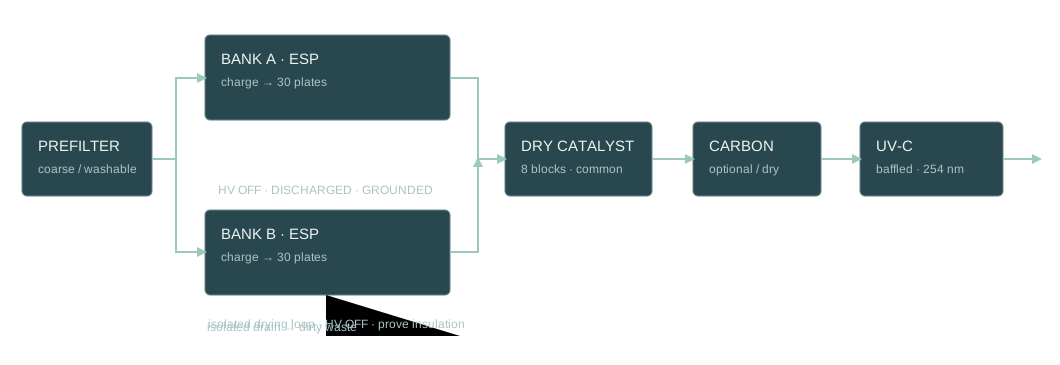
A coarse prefilter protects a positive-corona charging stage. Two electrostatic banks collect charged particles. Their combined airflow then passes through a dry ozone-destruction cartridge, optional carbon and an enclosed, baffled UV-C chamber.
THE ARCHITECTURE, OPENED UP
Follow the air. Then follow the wash.
Parallel collection. One downstream finish. Choose a mode to see which paths stay open.
Functional topology. Spray, drainage and drying belong inside an isolated ESP bank. Catalyst, carbon and UV stay dry and outside the spray path. Motion represents routing, not measured particle efficiency.
Both banks filter. Total system airflow remains 150 m³/h on the planning basis; the shared catalyst is sized for that combined flow.
A washable first line.
A removable metal screen or washable cotton/hemp prefilter catches lint and coarse dust before the charging section. Resistance and fiber retention still need specification.
Natural cloth has no assumed fine-particle or gas-removal rating.
MADE CONCRETE
Look closer. The details matter.
Reference dimensions and proposed interfaces make the concept tangible. Full packaging remains part of the design work.
COLLECTOR EXAMPLE
30 plates per bank
Each plate is 300 mm high × 400 mm along airflow, with 29 clear gaps of 8 mm. Grounded collecting area is 3.48 m² per bank; supports add blockage.
COMMON CATALYST
200 × 200 × 200 mm
Eight 100 mm blocks make the media envelope. Housing, seals and distribution space are additional. Nominal empty-bed contact time is 0.192 s at 150 m³/h.
SERVICE EXAMPLE
5 L per bank / wash
An assumed 3-minute spray at 1 L/min plus 2 L fresh rinse. Coverage, drying time and real water demand remain to be established.
OPEN ABOUT WHAT GOES INTO IT
A clear media allowance. An open system budget.
USD component references, historical source snapshots and clearly visible gaps.
Honeycomb catalyst · 8 blocks$400
Historical supplier listing · Oct 6–7, 2026
Eight × $50 for 100 mm blocks. Media only; composition, pressure drop, bypass sealing and ozone performance still require confirmation.
Effectiveness is not yet rated. The idealized plate example gives about 57%, 92% and 98.5% collection for three assumed migration velocities; these are sensitivities, not measurements. A useful product claim needs size-resolved removal, measured clean-air delivery, ozone emissions and loaded-service performance.
Is this HEPA-free?
Yes, the design uses electrostatic collection rather than HEPA media. That choice does not establish HEPA-equivalent efficiency. It trades a disposable fine filter for high-voltage hardware, washing, drying, ozone control and service access.
Does washing stop all filtration?
Two isolatable banks are intended to allow continued filtration, provided each bank can carry the required flow alone. During washing the affected bank is closed, discharged and grounded. The downstream catalyst and UV are outside the spray circuit.
Does this remove CO₂ or every gas?
No. The ESP addresses particles; the catalyst targets ozone; optional carbon is compound-specific; UV addresses susceptible microbes within a qualified dose envelope. Closed-cabin CO₂ removal and fresh-air management require their own system.